Three papers in one year on the question this series kept running into: once a system knows you are struggling, what should it actually do about it?
By the end of 2024 the sensing question had a reasonable answer. You can tell when somebody is loaded, uncomfortable or about to be sick, and you can often do it with hardware that is already in the headset.
What none of that work could tell me was what the system should do about it. Displaying the number to a person turned out to be close to useless. So the obvious alternative is for the system to act on your behalf, which sounds fine until you ask who is in charge of the interface.
Three papers from 2025 attack that from three directions. None of them solves it. Together they map the shape of the problem better than anything I had before.
1. Explain it to whoever can actually act
VRSense is the direct descendant of the dataset from part 3. It is the first detailed analysis of VR.net, using 161 hours of gameplay from 411 participants, and it starts from the observation that a cybersickness prediction is not an intervention.
If a model says "this player is going to feel sick," the player can do nothing with that except take the headset off. The person who can actually fix it is the developer who built the scene.
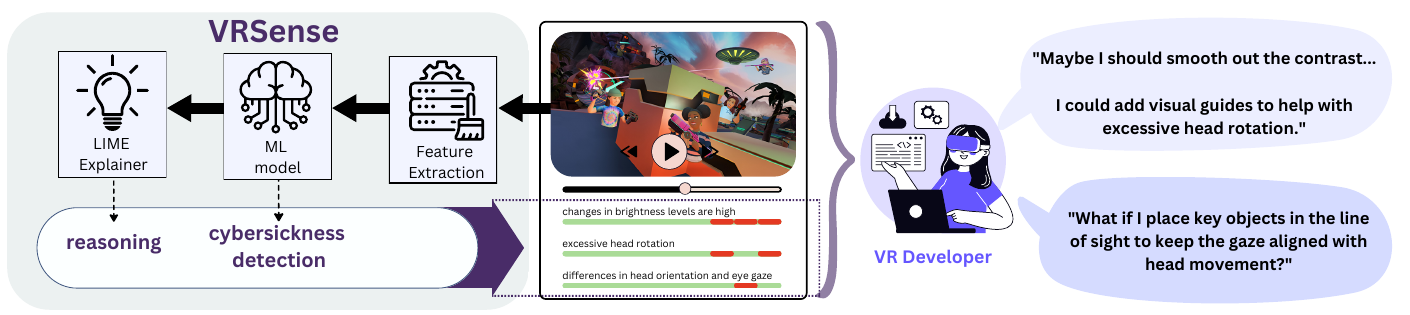
So VRSense wraps the classifier in LIME and surfaces the reasons alongside the prediction. Not "sickness likely at 4:20", but "changes in brightness levels are high, excessive head rotation, differences between head orientation and eye gaze". Those are things a developer can go and change.
Two honest notes. The best baseline model in the paper reaches 60% accuracy with an F1 of 0.67, which is a starting point rather than a result. And my favourite finding is not from the model at all: in games where players can choose to fly instead of walk, the ones who chose to fly got sicker. The dataset also shows differences in reported sickness between male and female participants, which matters because prior VR sickness studies have historically under-recruited women.
The shift here is small but it changed how I think. Adaptation does not have to mean the system acting on the user in real time. It can mean the system telling the one human in the loop who has the power to fix the underlying cause.
2. The automation you add is control you take
The second paper is the one that unsettled me most, and it was led by Xiliu Yang at the University of Stuttgart. It asks what happens when AR assistance becomes adaptive enough to start making decisions for you.
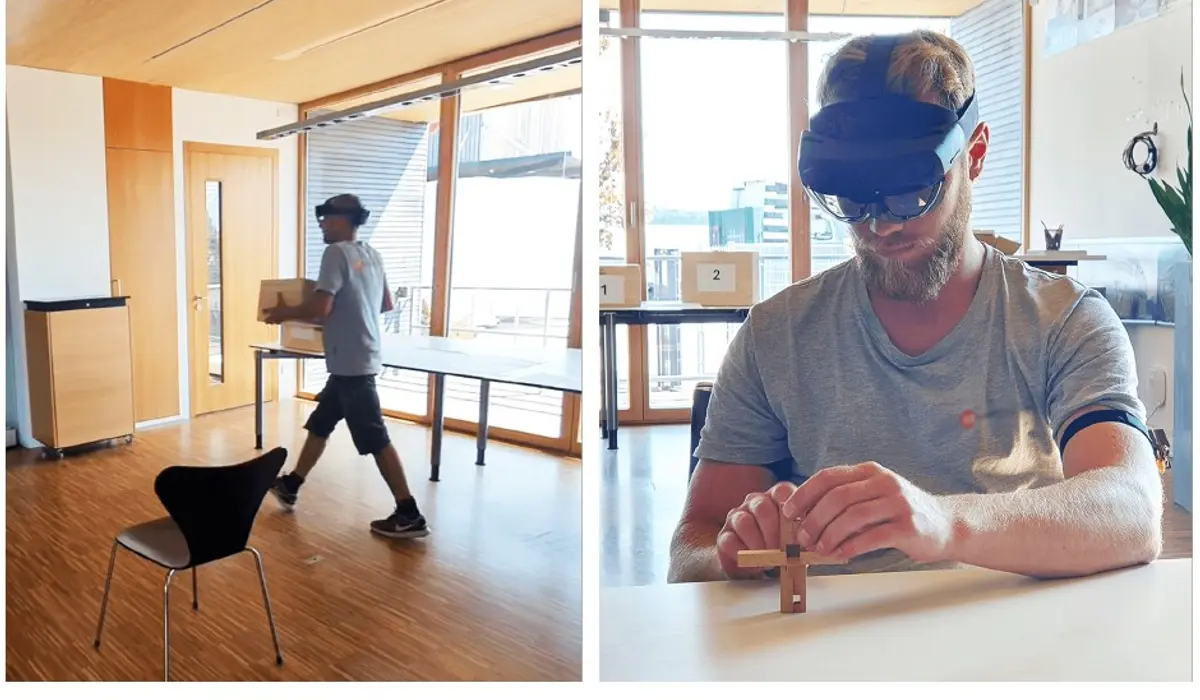
The setting is timber construction. An AR system that detects your assembly state and shows the right instruction at the right moment, adjusting to your attention and workload, is exactly the kind of thing the rest of this series has been building toward. The study compares that against a low-automation version where the worker triggers everything themselves.
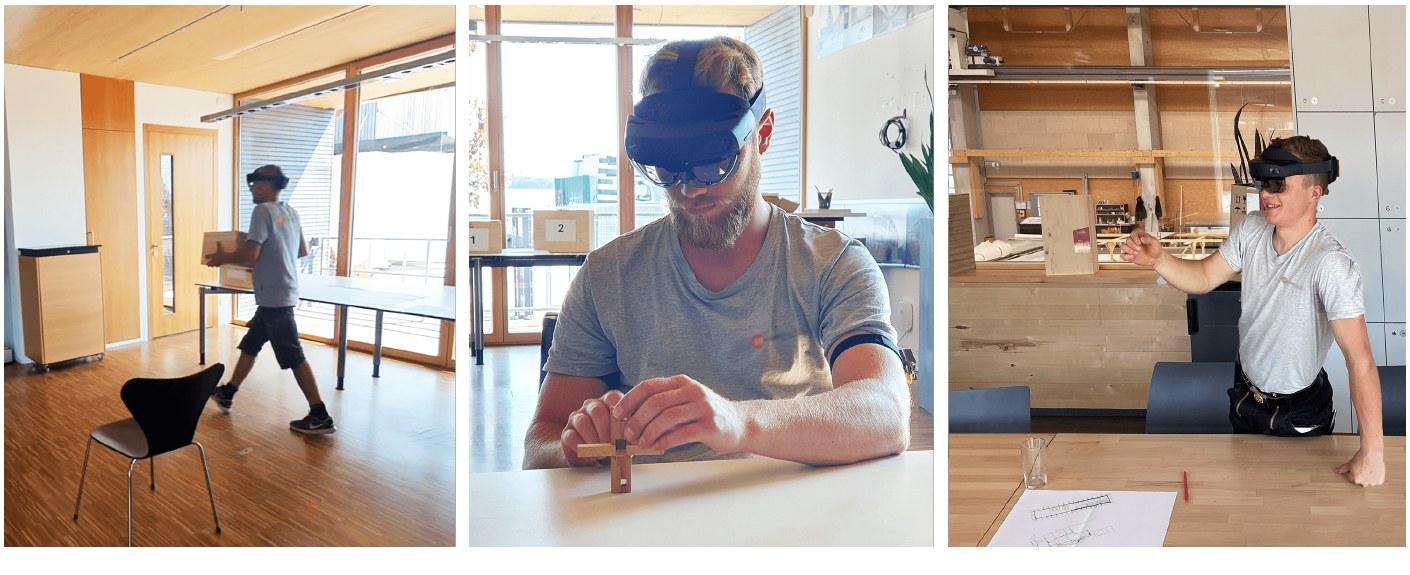
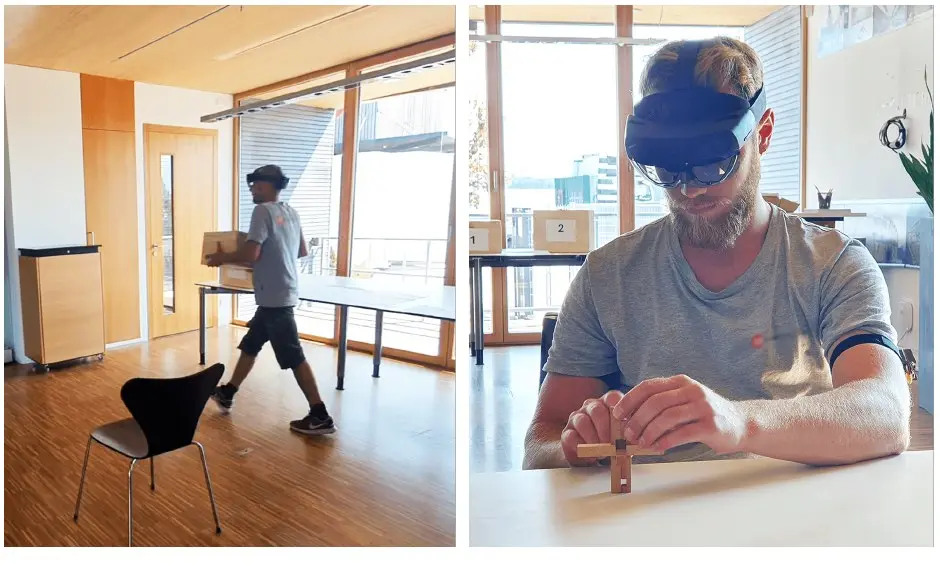
A lab study with 24 participants, then a follow-up with 8 trained carpenters in an ecologically valid setting, with interviews.
Low-agency control reduced mental workload. It also reduced perceived autonomy.
That is not a bug to be engineered away. It is the actual trade. Every piece of context-awareness you add removes a decision the person used to make, and for someone whose skill is precisely their judgment about the work, that removal is not experienced as help. The carpenters were not confused by the automation. They were trained professionals being quietly demoted by it.
I do not think there is a setting of the dial that is correct for everyone. Which means "how much should the system take over" is a design question that has to be answered per context, per task, and probably per person, and my instinct that more adaptation is better was wrong.
3. Stop guessing what helps
The third one is smaller and it is a process paper rather than a result, but it fixed a hole I had not admitted was there.
Everything up to this point was built by engineers deciding what a supportive response looks like. In the empathic photography work we detected stress and had a virtual companion say something soothing, and the tone of that line was chosen by us, based on nothing.
Co-Designing Stress Interventions in Mixed Reality with Mental Health Experts ran participatory design sessions with five clinicians and mental health experts, working through visual aesthetics, breathing guidance, audio, and how the environment should progress.
The expert input changed real decisions. Enclosed forest scenes carry a claustrophobia risk for trauma patients. Sunrise imagery reminds people of the working day ahead. A human-like guide can feel like being watched by someone who is judging you, particularly for anyone dealing with social anxiety. None of that is knowable from inside a lab that builds headsets.
That process became Zenflow, which is the first system in this whole arc that I think genuinely helps somebody, and it is not a coincidence that it is the one where I was not the person deciding what help looks like.
Where that leaves it
Three answers to the same question, and they do not fully agree.
- Explain, do not just detect. And explain to whoever can act, who is often not the user.
- Automate carefully. Comfort and agency trade against each other, and taking work off an expert's hands can read as taking the work away from them.
- Do not design the intervention alone. The detection is the engineering problem. What to do about it is somebody else's expertise.
Sensing was the part I was trained for, and it turned out to be the easy half. The series started in 2022 with me arguing that headsets should read the body. They can. Four years later the interesting question is not whether the machine can tell how you feel. It is what gives it the right to do anything about it.
The papers are VRSense: An Explainable System to Help Mitigate Cybersickness in VR Games (CHI EA 2025, with Dinithi Dissanayake, Chitralekha Gupta and Suranga Nanayakkara), Who is in Control? Understanding User Agency in AR-assisted Construction Assembly (CHI 2025, led by Xiliu Yang with Felix Amtsberg, Achim Menges, Michael Sedlmair and Suranga Nanayakkara), and Co-Designing Stress Interventions in Mixed Reality with Mental Health Experts (ISMAR Adjunct 2025, with Praveen Sasikumar and Suranga Nanayakkara).